Zooplankton Community Structure
|
|
View Data
|
|
To assist in the interpretation of the data, it can be displayed
using the Hawaii Ocean Time-series Data Organization &
Graphical System (HOT-DOGS©).
|
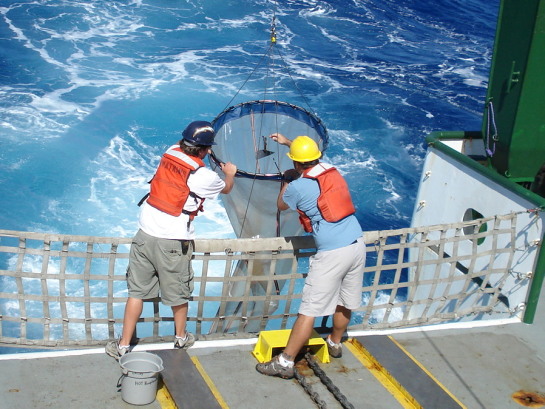
SUMMARY: Zooplankton (weak swimmers > 200-µm) are collected
using oblique tows of a 1-m2 net (202-µm mesh
netting) from the surface to approximately 175 m depth. A live
silhouette photograph is taken of the catch, then the catch is
size fractionated and each fraction analyzed for C, N, and gut
fluorescence.
1. Principle
Large zooplankton and micronekton are believed to play important roles
in the export of organic material from surface waters in the open
ocean. Global Ocean Flux planning models suggest that the relationship
between primary production and passive particulate export flux is
strongly influenced by size structure of the zooplankton community
(e.g., Frost, 1984). Active vertical migrations also have important
implications for the transport and transformation of surface-derived
organic particulates to dissolved inorganic constituents at depth
(Longhust & Harrison, 1988; Longhurst et al., 1990). The zooplankton
component of the time-series sampling effort allows such processes to
be considered in the interpretation of seasonal and interannual
variations in measured flux and the elemental mass balance (e.g.,
carbon and nitrogen sources and sinks) of the euphotic zone.
At Station ALOHA, 6 net tows are scheduled per cruise. Three
midnight (2200 - 0200) and 3 mid-day (1000 - 1400) oblique tows are
done using a 1-m2 net (3 m length) with 202-µm mesh
Nitex netting. The net is towed obliquely at approximately 1 knot,
from the surface to approximately 175 m and then back to the surface.
Towing time is approximately 20 minutes. The tows are subsequently
analyzed for macrozooplankton biomass and bulk gut fluorescence. In
addition, live silhouette photographs are taken.
2. Precautions
The net tow sample should be processed as soon as possible after
collection because zooplankton gut fluorescence is to be measured.
Further, in order to slow gut evacuation, approximately 1/10 volume of
cold club soda is added directly to the cod end sample to narcotize the
animals.
3. Field Operations
- 3.1 Hardware
In order to collect meso- and macrozooplankton (weak
swimmers > 200-µm), as well as micronekton (shrimps,
small fishes, and juvenile squids), we use a 1-m2 single-
net frame with wire attachments and weighting similar to
a MOCNESS. We are not assuming that our micronekton
sampling will be quantitative since even very large nets
(7.3 m2 Isaacs-Kidd midwater trawl and 96 m2 Cobb nets)
towed relatively fast (4 and 2 knots, respectively) do
not capture all micronekton equally well (Kuba, 1970).
The net used is 202-µm (3-m length) since fecal debris
of smaller organisms probably contribute little to flux
(Paffenhffer & Knowles, 1979; Small et al., 1987). The
net is outfitted with a flow meter with a low speed
rotor (Model 2030R, General Oceanics, Miami, FL) that is
attached across the net opening and a temperature-
pressure data logger (Model XL-200, Richard Brancker
Research, Ottowa, Canada) fastened to the net frame.
- 3.2 Post-recovery processing
- 3.2.1
At the end of the tow, the outer side of the net
is sprayed down with surface seawater to concentrate
the animals in the collecting bucket. The collection
bucket is removed, and approximately 1/10 volume of
cold club soda is added to narcotize the animals with
carbon dioxide to slow gut evacuation.
- 3.2.2
As soon as possible after collection, the sample
is split using a Folsom plankton splitter. Subsamples
are taken for size-fractionation, preservation, and
silhouette photography. Size-fractionation is
accomplished using nested filters of the following
mesh sizes: 5-mm, 2-mm, 1-mm, 500-µm, and 200-µm.
Each fraction is concentrated on to a 47-mm 200-µm pre-
weighed Nitex filter, rinsed with isotonic ammonium
formate, placed in a labelled cryotube, and then flash-
frozen in liquid nitrogen.
- 3.2.3
Half of the tow is preserved in borate-buffered
formaldahyde (0.5% final concentration), with
strontium chloride (0.27 mM final concentration) added
to aid in preservation of acantharians. The samples
are stored in borosilicate-glass jars.
- 3.2.4
A live silhouette photograph is taken on a
subsample (generally 1/8 to 1/16th) of the tow, using
the method of Ortner et al. (1979). The flash unit
(Model FX6A, EG & G Electro-Optics, Salem, MA) is
positioned 10" above a piece of fine-grain sheet film
(8" x 10", Kodak #7302). The sample is poured on to
the film, then exposed. Developing chemicals are
Dektol developer (diluted 1:2, Kodak #1464700),
indicator stop bath (Kodak #1464247), rapid fixer
(Kodak #1464106), hypo-clearing agent (Kodak
#1533942), and photo-flo 200 (Kodak #1464502).
4. Determination of Mass
- 4.1.
Liquid nitrogen-frozen samples are stored at -85C
until processed. Then, they are defrosted at room
temperature in the dark on a paper towel to blot excess
moisture. Each sample (which represents a single size-
fraction of the tow) is weighed wet on an analytical
balance before (total fraction wet weight) and after
subsamples of the zooplankton mass are set aside for
gut pigment analysis and carbon/nitrogen biomass. The
remaining sample is dried at 60øC, and then reweighed
for determination of the fraction's mass (total sample
mass is the sum of all fraction masses). The mass of
the sample is normalized to the ocean surface area
using the volume of seawater filtered through the net
as recorded by the flow meter (= volume filtered) and
the depth to which the net fished as recorded by the
data logger (= depth).
- 4.2. Calculation of fraction dry weight:
(1) dwt1 = (wwt1 - fwt) - [(wwt1 - fwt) * %water]
(2) %water = [(wwt2 - fwt) - (dwt2 - fwt)] / (wwt2 - fwt)
where:
dwt1 = fraction dry weight (mg)
dwt2 = fraction dry weight (including filter weight)
after all subsamples removed (mg)
wwt1 = fraction wet weight including filter weight (mg)
wwt2 = fraction wet weight including filter weight after
all subsamples removed (mg)
fwt = 47-mm 200-µm filter weight (mg)
%water = water content of fraction (assume water content
is the same for wwt1 and wwt2)
- 4.3. Calculation of fraction mass:
(3) mg (dry wt.) m-2 = dwt1 * depth * (volume
filtered)-1 * (fraction of tow)-1
where:
depth = towing depth from data logger pressure
trace (m)
volume filtered = volume of seawater filtered through
net from flow meter reading (m3)
fraction of tow = fraction of tow concentrated in
each size-fraction (e.g., 1/2 or 1/4)
5. Gut fluorescence
- 5.1.
Gut pigment analysis subsamples are kept in the dark
at room temperature until processed. They are
processed within 2 - 3 hours of thawing. Samples are
homogenized, along with a small piece of glass fiber
filter paper to provide friction, in 90% acetone using
a tissue grinder. They are then filtered to remove
particulate material and kept in the dark until
fluorometric analyses (Turner Model 112 fluorometer) of
chlorophyll a (chl a) and phaeopigment can be done
(within 2 hours of extraction).
- 5.2.
The fluorometer is turned on and allowed to
stabilize for 30 minutes prior to running the first
sample. The machine is then zeroed with 90% acetone
and the samples are analyzed. The chl a reading is
recorded, then the sample is acidified with 2 drops 1M
HCl and the phaeopigment reading is recorded. Both of
these readings are taken from the sample using the same
door of the fluorometer. Each time the door is
changed, the machine is rezeroed.
- 5.3.
A chl a standard (Sigma Chemical Co., St. Louis, MO,
#C6144) is analyzed along with each batch of sample.
The standard is diluted so that it can be analyzed on
more than one door setting of the fluorometer. The
ratio of the reading before acidification to the
reading after acidification is used to calculate the
concentration of pigment in the batch of samples run
that day. A batch of standard is made by dissolving
the chl a in 90% acetone. The concentration of the
standard is determined using its absorbance at 662 nm
and the extinction coefficient for chl a provided by
the supplier. The chl a stock is wrapped in aluminum
foil and stored at -20C. The instrument is calibrated
at yearly intervals (Strickland and Parsons, 1972) or
whenever the chl a standard indicates a shift in the
calibration constants.
- 5.4.
The mass of the pigment subsamples is determined
from the wet weight mass as follows:
(4) dwt = wwt - (wwt * %water)
where:
dwt = dry weight of pigment subsample
wwt = wet weight of pigment subsample (see Section 4)
%water = water content of fraction (from Section 4,
equation 2)
- 5.5.
Concentrations of chl a and phaeopigments are calculated using
the following equations:
(5) chl a = (T/(T-1)) * (Rb - Ra) * Fd * vol ex * dwt-1
(6) phaeo = (T/(T-1)) * ((T*Ra) - Rb) * Fd * vol ex * dwt-1
where:
chl a = concentration of chl a (µg g dwt-1)
phaeo = concentration of phaeopigments (µg g dwt-1)
T = acidification coefficient (Rb/Ra average obtained
during the calibration of the fluorometer)
Rb = reading before acidification
Ra = reading after acidification
Fd = door factor (µg liter-1)
volex = volume of extraction (l)
dwt = dry weight of sample (equation 4)
- 5.6. Calculation of fraction pigment content:
(7) chl a (µg) m-2 = chl a * dwt1 * depth *
(volume filtered)-1 * (fraction of tow)-1
(8) phaeo (µg) m-2 = phaeo * dwt1 * depth *
(volume filtered)-1 * (fraction of tow)-1
where:
chl a = concentration of chl a (µg g dwt-1--equation 5)
phaeo = concentration of phaeo (µg g dwt-1--equation 6)
dwt1 = fraction dry weight (g) (equation 1)
depth = towing depth from data logger pressure trace (m)
volume filtered = volume of seawater filtered through
net from flow meter reading (m3)
fraction of tow = fraction of tow concentrated in each
size-fraction
6. Particulate C and N
- 6.1.
Carbon and nitrogen biomass are determined using a
CHN Elemental Analyzer (Perkin Elmer Model 2400) on
subsamples which have been dried at 60 deg C in pre-weighed
combusted aluminum foil boats and then weighed on an
analytical balance (to 5-places)(see Chapter 10,
sections 4 - 8). The dry weight of the sample is the
difference between the final balance weight (sample +
boat weight) and the pre-weighed boat weight.
- 6.2. Calculation of carbon and nitrogen content of fraction:
(9) C (mg) m-2 = C * dwt1 * depth * (volume filtered)-
1 * (fraction of tow)-1
(10) N (mg) m-2 = N * dwt1 * depth * (volume filtered)-
1 * (fraction of tow)-1
where:
C = concentration of carbon (mg g-1)
N = concentration of nitrogen (mg g-1)
dwt1 = fraction dry weight (g) (equation 1)
depth = towing depth from data logger pressure trace (m)
volume filtered = volume of seawater filtered through
net from flow meter reading (m3)
fraction of tow = fraction of tow concentrated in
each size-fraction
7. Equipment/Supplies/Reagents
- net assembly (net frame, net, flow meter, data logger,
bridle, towing line)
- club soda, 1 can per tow, cold
- seawater hose
- Folsom plankton splitter
- Nested filter set (200-, 500-, 1000-, 2000-, 5000-µm
Nitex, each glued to the bottom of a plastic bowl)
- forceps (Millipore)
- filtered seawater (0.45 µm) in squirt bottles
- 47-mm filter apparatus (tower and base)
- 47-mm 200-µm pre-weighed Nitex filters
- Cryotubes and caps
- Isotonic ammonium formate (1 M)
- Liquid nitrogen
- Borate-buffered formaldehyde (10% Formalin, 79 mM
Sodium tetraborate, pH 8.0)
- Strontium chloride (13.5 mM)
- Flash unit apparatus (bulb, stand, film/sample holder)
- Developing chemicals: Dektol developer (diluted 1:2,
Kodak #1464700), indicator stop bath (Kodak
#1464247), rapid fixer (Kodak #1464106), hypo-
clearing agent (Kodak #1533942), and photo-flo 200
(Kodak #1464502).
- Fine-grain sheet film (8" x 10", Kodak #7302)
- Analytical balance (4- and 5-place)
- Spatula
- Ethanol (for rinsing)
- Filter pieces (small)
- Pre-weighed, combusted aluminum foil boats
- Petri dishes
- Oven (60C)
- Acetone (90%)
- Tissue grinding apparatus (motor, mortar, pestle)
- Filtration apparatus (25-mm base and 15 ml tower,
tubes, vacuum)
- Glass tubes (size?)
- Turner 112 Fluorometer with chl filters and Phinney
bulb (Philips F4T5/BL)
- CHN Elemental Analyzer (see Chapter XX)
8. Results
Temporal variation in mesozooplankton biomass during HOT year 16
(2004) is presented in Figure 64. Both
zooplankton dry weight biomass (upper panel) and wet weight biomass
(lower panel) are plotted. On average, zooplankton dry weight biomass
was 12% of zooplankton wet weight biomass during the day and 13% during
the night.
Nighttime dry weight zooplankton biomass during 2004 (1.36 g DW
m-2 ± 0.327 g DW m-2) was approximately
1.63 times that of zooplankton collected during the day (0.887 g DW
m-2 ± 0.268 g DW m-2). Wet weight biomass
of zooplankton differed similarly during the night (10.4 g WW
m-2 ± 2.48 g WW m-2) and day (7.43 g WW
m-2 ± 2.31 g WW m-2), and night wet
weights were 1.51 times day wet weights. The difference in biomass
between zooplankton collected during the night and zooplankton
collected during the day at Station ALOHA was significant for both dry
and wet weights (Student's T-test, n=11, p<0.01), and was caused by the
upward migration of deep-living zooplankton and micronekton after
sunset.
Mesozooplankton dry weight biomass averages during HOT year 16 are
slightly higher than averages for all eleven years of the zooplankton
program (1994 - 2004: night = 1.10 g DW m-2 ± 0.341
g DW m-2; day = 0.705 g DW m-2 ± 0.277 g
DW m-2). Nighttime dry weight biomass was significantly
greater during year 16 (2004) than during 1994, 1995, 1996, 1997, 1998
and 1999 (Mann-Whitney U test, n≤12, p≤0.05). Nighttime biomass during
2000, 2001, 2002 and 2003 did not differ significantly from year 15
(2003). This pattern was similar for daytime zooplankton biomasses.
Daytime dry weight biomass was significantly greater during year 16
(2004) than during 1994, 1995, 1996, 1997 and 1999 (Mann-Whitney U
test, n≤12, p≤0.05), whereas daytime biomass during 1998, 2000, 2001,
2002 and 2003 did not differ significantly from year 16 (2004).
9. References
Frost, B.W. 1984. Utilization of phytoplankton production in
the surface layer. Pages 125-134 in Global Ocean Flux
Study: Proceedings of a Workshop, September 10-14, 1984.
Kuba, D.M. 1970. Sampling midwater fish using the ten-foot
Isaacs-Kidd midwater trawl and the Cobb pelagic trawl. MS
Thesis, Univ. Hawaii, 35 pp.
Longhurst, A.R. and W.G. Harrison. 1988. Vertical nitrogen
flux from the oceanic photic zone by diel migrant
zooplankton and nekton. Deep-Sea Res. 35: 881-890.
Longhurst, A.R., A. Bedo, W.G. Harrison, E.J.H. Head and
D.D. Sameoto. 1990. Vertical flux of respiratory carbon by
oceanic diel migrant biota. Deep-Sea Res. 37: 685-694.
Ortner, P.B., S.R. Cummings, R.P. Aftring and H.E. Edgerton.
1979. Silhouette photography of oceanic zooplankton.
Nature 277: 50-51.
Paffenhfer, G.-A. and S.C. Knowles. 1979. Ecological
implications of fecal pellet size, production and
consumption. J. Mar. Res. 37: 35-49.
Small, L.F., G.A. Knauer and M.D. Tuel. 1987. The role of
sinking fecal pellets in stratified euphotic zones. Deep-
Sea Res. 34: 1705-1712.
Strickland, J.D.H. and T.R. Parsons. 1972. A Practical
Handbood of Seawater Analysis, Fisheries Research Board of
Canada, 167 pp.
|