HALE-ALOHA: Introduction
The inaugural deployment of the HALE ALOHA physical-biogeochemical
mooring at Station ALOHA (hereafter called HALE ALOHA - I) was
successfully completed on Sunday, 12 January 1997 by a team of
scientists aboard the R/V Moana Wave (D. Karl, chief scientist).
I. Mooring Configuration
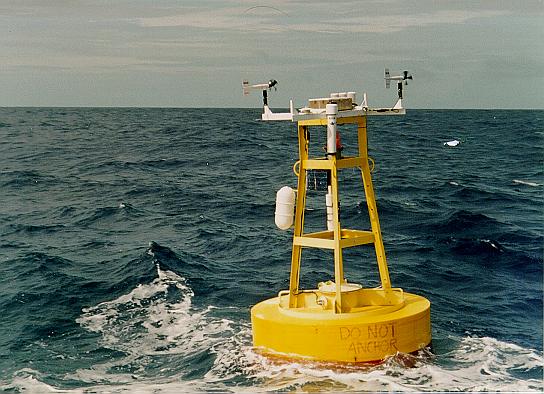
HALE ALOHA - I is configured as a semi-taut
mooring consisting of a 3-m diameter Guardian style buoy with running
lights, radar reflector, solar panel and Argos satellite position-only
transmitter (and scientific instrumentation detailed below), 3/8"
plastic jacketed torque balanced, wire rope and 3/4" chain (0-125 m),
5/16" plastic jacketed torque balanced wire rope (125-2000 m), 3/4"
nylon line (2000-3500 m) -- short spliced to 3/4" polypropylene line
(3500 - 5000 m), 36 - 17" glass floatation spheres on 34 m 3/8" chain
(5000-5034 m), dual Benthos model 865A deep-sea acoustic releases on a
stainless steel mount (5034-5035 m), 5 m of 1/2" chain (5035-5040 m),
10 m of 1" nylon line (5040-5050 m), 5 m of 1/2" chain (5050- 5055 m),
3600# (wet weight) anchor; total water depth (4830 m).
II. Scientific Instrumentation
- Meteorological instruments on the HALE ALOHA buoy (scientist in
charge: Pierre Flament, UH)
| Qty
| Description
| Model
| Manufacturer
|
| Instruments:
|
| 2
| marine anemometer
| 5106
| R.M. Young
|
| 2
| meteorological probe w/multi-plate radiation shield
| MP101A
| Rotronic
|
| 1
| rain gauge
| 50203
| R.M. Young
|
| 1
| Precision Spectral Pyranometer w/aluminum base
| PSP
| Eppley Labs
|
| 1
| air/water temp difference thermocouple (experimental)
| N/A
| N/A
| |
|
| Data Logging System:
|
| 1
| data logger
| 21X
| Campbell Sci.
|
| 1
| 4-channel relay driver
| A21REL-12
| Campbell Sci.
|
| 1
| card storage module (w/2Mb memory card)
| CSM1
| Campbell Sci.
|
- Sampled parameters
| # Measurements
| Description
| Rate
|
| 2
| wind speed (m/s)
| 2 min average every 10 min
|
| 2
| wind direction (deg az)
| "
|
| 2
| relative humidity (%)
| 1 sample every 10 min
|
| 2
| air temperature (Deg C)
| "
|
| 1
| rain accumulation (mm)
| "
|
| 1
| solar radiation (W/m2)
| "
|
| 1
| air/water temp diff (Deg C)
| "
|
| 1
| buoy azimuth (Deg)
| "
|
| 1
| equipment box temp (Deg C)
| "
|
| 1
| battery voltage (V)
| "
|
| Note: Some parameters are logged as voltages and
converted to SI units during post processing.
|
This present effort is being funded through a NSF Academic Research
Infrastructure (ARI) grant #OCE96-01850, awarded to D. Karl, R. Lukas
and P. Flament.
Temperature (scientists in charge: Dave Karl and Terry
Houlihan, UH)
Ocean temperature data loggers are deployed at depths of 2 m (2
instruments attached to the subsurface portion of the buoy) and at
40, 50, 60, 80, 90, 100, 110, 120, 130 and 150 m (1 instrument per
depth).
Description: The Richard Brancker Research (Rbr) XX-105 is a single
channel data logger with a built-in, high stability YSI46033
thermistor. It has an operating range of +5 Deg C to +30 Deg C and
resolution of 0.002 Deg C to 0.005 Deg C with the variation in
resolution due to the non-linear response of the thermistor used.
The loggers were programmed to sample every 30 min from 1/12/97
until 5/10/97. This should fall within the power potential
recommended by the battery manufacturer for the AA alkaline
batteries. This present effort is being funded through a NSF
Academic Research Infrastructure (ARI) grant #OCE96-01850, awarded
to D. Karl, R. Lukas and P. Flament.
Optical sensor (scientists in charge: Ricardo Letelier and Mark
Abbott, OSU)
Description: A Downwelling Irradiance sensor (OCI-200, Satlantics
Inc., Canada) and an Alpha-Omega datalogger (Alpha-Omega, USA) are
the principal components of the Downwelling Irradiance Monitoring
system deployed at 25 m. Seven discrete channels with 10 nm
bandwidth centered at 412, 443, 490, 510, 555, 670 and 680 nm
measure the downwelling irradiance which is recorded every 20 min in
the datalogger. Initially, the data collected will be used to
estimate the temporal variability of dissolved organic matter,
chlorophyll and chlorophyll natural fluorescence in the upper layer
of the euphotic zone at Station ALOHA. This present effort is being
funded through the NASA grant NAS5-31360 awarded to M. R. Abbott.
Gas tension device / Seacat (scientist in charge: Steve Emerson
and Chuck Stump, UW)
Description: This instrument, deployed at 50 m, provides a novel
method of inferring dissolved N2 and O2 gas
concentrations in seawater based on a local measurement of gas
tension, water temperature and salinity. The gas tension device
(Gtd) is identical in design to that described by McNeil et al.
(Deep-Sea Research 42: 819, 1995) and has been previously
field tested at Sta. ALOHA prior to the mooring deployment. An
integrated Seacat provides the necessary C/T and O2
measurements.
Nitrate osmoanalyzers (scientist in charge: Hans Jannasch,
MBARI)
Description: In situ osmotically pumped nitrate analyzers
(OsmoAnalyzers) are deployed at 120 and 180 m to monitor nitrate
intrusions into the mixed layer. These long-term submersible
chemical analyzers use zero-power osmotic pumps to propel sample and
reagents through a miniature reaction manifold. A simple
LED/photodiode detector measures the concentration of the azo-dye
produced by the standard sulfanilamide/NED colorimetric reaction for
determining nitrate concentrations in seawater. OsmoAnalyzers
automatically inject standard and blank solutions every 3 days for
in situ calibration. Added sensors integral to the analyzer
provide measurements of water temperature and salinity, the latter
by use of an inductive coil. This effort is funded by MBARI.
Intermediate Water Seacats (scientists in charge: Roger Lukas and
Craig Nosse, UH)
Description: SeaBird Electronics Seacat (SBE-16) conductivity and
temperature recorders are deployed at 410, 475, 540, 560, 650 and
785 m (1 instrument per depth). Seacats have a measurement range of
-5 to 35 deg C and 0 to 7 S/m (0 to 70 mmho/cm) with a resolution of
0.001 deg C and 0.0001 S/m. The Seacats were programmed to sample
every 10 minutes. This present effort is being funded through NSF
grant OCE-9303094 (The Hawaii Ocean Time-series Program: WOCE
Component).
MER2020A (scientists in charge: Dave Karl and Terry Houlihan, UH)
Description: The moored spectroradiometer is a battery powered
self-contained optical instrument that measures eight downwelling
irradiance wavelengths, eight upwelling radiance wavelengths, dual
axis angle sensors, pressure transducer and a log of battery voltage,
internal temperature, time and date. The irradiance detector array
views a single cosine-corrected optical collector optimized for use
in water. The radiance array uses individual Gershun tube radiance
collectors where the collection angle is constrained inside the
housing to remain within the SeaWiFS specifications.
III. Service Schedule
Monthly visits will be made to the HALE ALOHA mooring location during
regularly scheduled HOT cruises. Each month, a Ctd cast will be taken
at a safe distance from the mooring for the collection of water samples
for dissolved O2, nitrate and chl a determinations. If
possible, a mid-day light cast will also be taken. HALE ALOHA - I will
be recovered in May 1997 and redeployed within a week of recovery.
After a thorough evaluation of biofouling and other considerations, we
will determine an optimal duty cycle for the mooring (4-6 months).
During the May turnaround we plan to install a direct cellular phone
link for the meteorological data. Additional instruments may also be
added to HALE ALOHA in the future and we invite all potential users to
contact Dave Karl (email: dkarl@soest.hawaii.edu; phone: (808)
956-8964; fax: (808) 956-5059) if you have any questions.
IV. Data Availability and Distribution
As with all other HOT program data sets, HALE ALOHA mooring data,
including those obtained by ancillary investigators, will be
available to the community as soon after processing as possible.
These data will reside in a workstation at the University of Hawaii
and may be accessed using anonymous ftp on Internet or the World
Wide Web. More details will be posted after the mooring and its
suite of scientific instruments and data are successfully
recovered. Stay tuned!
|